PROGRAMS
Our Tuition-free Public Charter Program serves students from 4K through 12th grade.

Primary
4K & 5K

Elementary
Grades 1-6

Secondary
Grades 7-12
4K & 5K Primary (Ages 4-5 years)
Primary students enter the ‘first plane of development‘ where they learn spontaneously through their environment.
Primary classrooms are designed to allow children the freedom of movement and the choice of their own daily activities. Our materials are chosen to promote concentration, coordination, independence, and order, allowing children the opportunity to begin to make sense of the world around them. Grace and Courtesy lessons allow children to naturally develop a responsibility for themselves, the classroom, and others, through experiences with social skills and manners.
Through practice with our Practical Life, Sensorial, Mathematics, Language, and Cultural Studies materials, children develop a foundation for learning and for life. Our guides are trained to observe students throughout independent and group work, to determine the needs of each child individually. This observation allows guides to know when to present new material, which aids a child in understanding their strengths and skills on their own.
🕛 SCHOOL DAY: Monday-Friday, 8:15 AM-3:15 PM.
- All students will have a morning work cycle.
- 4K students will be given nap time in the afternoon. If they are not sleeping within the state-required time frame, they will be invited to return to the classroom to continue their work. Students will receive special enrichment programming in art, music, physical education, and Spanish.
- 5K students will have a second work cycle in the afternoon to meet state requirements.
PRIMARY CURRICULUM
Practical Life
The exercises, or work, in Practical Life focus on care of oneself, care of others, and care of the classroom environment. Practical Life work aids in the development of large and small motor skills, coordination, and independence.
Children may be presented lessons on washing a table, pouring water without spilling, and tying a bow. While these may seem to be simple tasks, they require each child to follow a complex process of steps, correcting themselves as they go, until they reach independence with a skill.
These exercises lead to self-discipline and a lifelong sense of responsibility. The skills gained through this work are the foundational skills of all subsequent learning in all areas of the classroom.
Sensorial
Children learn by exploring and interacting with the world around them while using their senses. The Sensorial area of the Primary classroom helps children develop a refinement of their senses, leading to a deeper understanding of the relationship between objects around them.
- Children may work with sorting different-sized cubes from large to small with our Pink Tower, or build different polygons with our Constructive Triangle Boxes to refine their visual sense.
- Working with our Thermic Bottles to differentiate between hot and cold, or our Touch Tablets to find rough and smooth, children will refine their tactile sense.
- Listening intently to our Sound Cylinders helps a child determine subtle differences in volume with their auditory sense.
- Smelling and Tasting Bottles encourage refinement of olfactory and gustatory senses.
The work in this area prepares the Mathematical Mind of the child by offering practice with exactness and order.
Mathematical
Through her studies, Maria Montessori determined that we have a Mathematical Mind. This refers to our natural tendency, as humans, for order, exactness, and orientation. She designed our math materials with this knowledge.
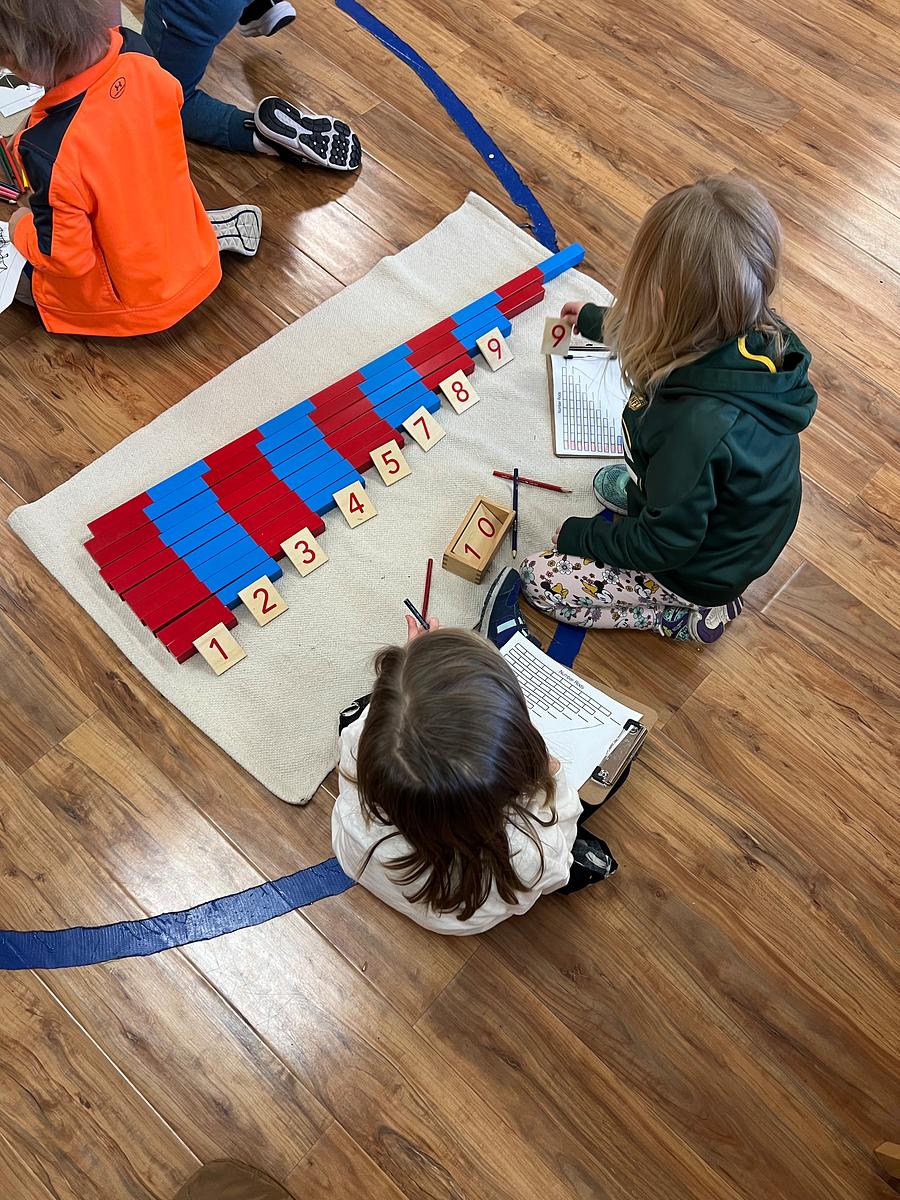
Our math materials focus on quantity, symbol (number), and the relationship between the two. The materials introduce children to each concept concretely to internalize what they are actually learning or doing. They are able to hold and manipulate the concept they are learning about, with their own hands. A child can feel the difference between one unit bead and one thousand unit beads put together to form a cube. The many math materials allow a concept to be introduced to each individual child in the way that they learn best.
Language
With their Mathematical Mind, children are drawn to order and logic in the world around them. For this reason, Montessori language materials focus on phonetic sounds of letters first.
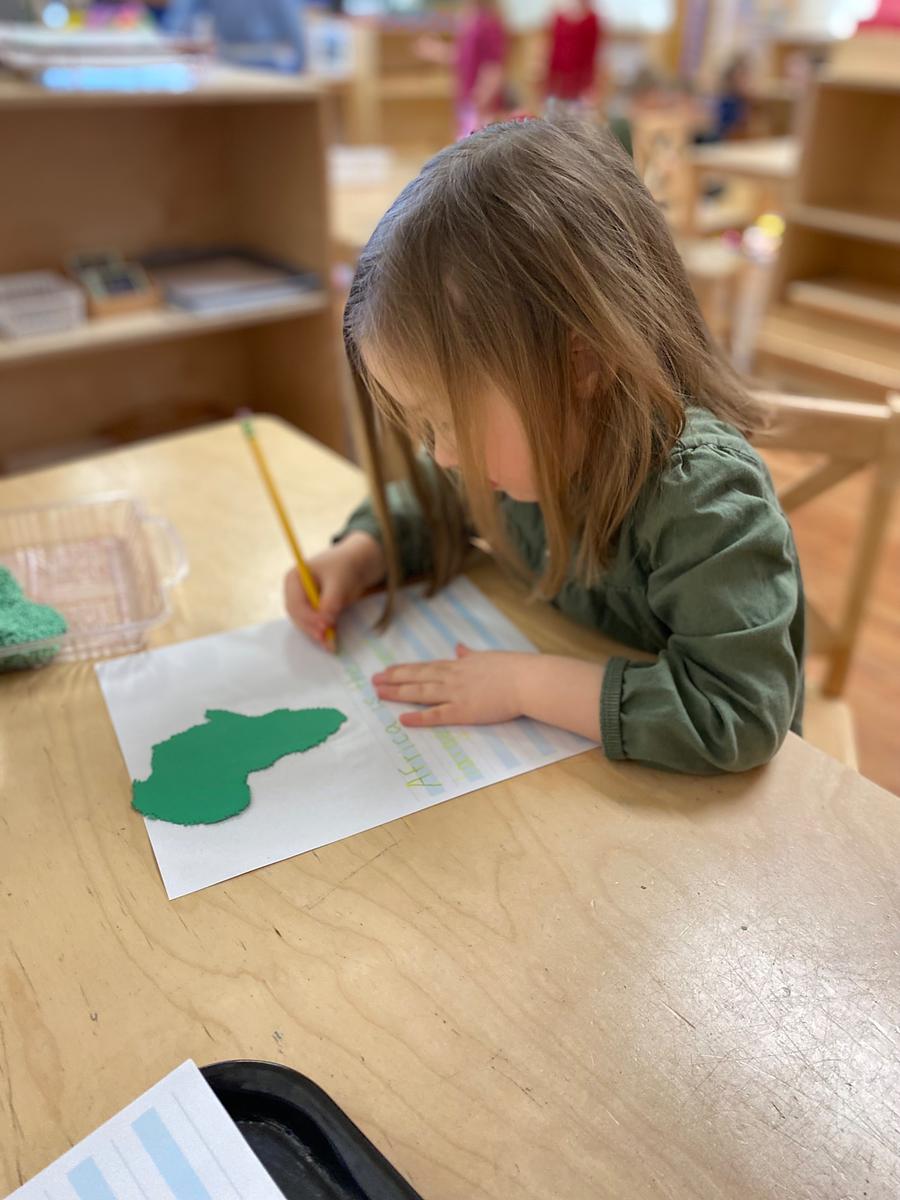
Children are introduced to letter sounds with our Sandpaper Letters. This allows children to hear the sound a letter makes while also feeling the way it is formed. At the same time, children can work with materials that introduce new vocabulary, sequencing of events, isolation of sounds in words, and even “writing” their own words with our Moveable Alphabet.
Our focus on phonics and vocabulary leads to an understanding of the “rules” of the English language at an age where children are sensitive to the language use around them and are wanting to understand it for themselves.
Cultural Studies
Dr. Montessori believed that at a young age, children begin to understand that they are part of a larger community. To help young children understand their global community and live with others in peace, Montessori created cultural lessons to introduce children to the experiences of others throughout the world.
Our materials introduce children to many types of animals and different human cultures so they can begin to learn to appreciate the importance of our similarities and celebrate our differences. Throughout this practice of peace, children discover how to communicate disagreements and come to a solution of peace together, preparing them for friendships and interactions with others as adults.
The only thing the absorbent mind needs is the life of the individual; give him life and an environment and he will absorb all that is in it.

Elementary (Grades 1-6)
Elementary students enter the ‘second plane of development’ leaving behind the absorbent mind and developing a more conscious mind.
The Elementary program includes Lower Elementary (1st-3rd grade) and Upper Elementary (4th-6th grade).
This begins the second plane of development, focusing on communication, collaboration, critical thinking, and creativity. They are ready to abstract the concrete experiences they had in preschool and kindergarten for a deeper understanding. Independent work and lesson presentations tend to be more varied and less repetitive. Children at this age are more interested in interacting with their peers and understanding the inner workings of interpersonal relationships. This age is less a time for order, and more time for morality, justice, and imagination.
Students will explore a wide range of subjects that are integrated through meaningful, hands-on work and real-world connections. Students will be provided with a rigorous curriculum of language, grammar, math, geometry, physical science, earth science, life science, geography, and history during their morning work cycles. Afternoons will be filled with literacy groups, art, music, physical education, Spanish, and more.
🕛 SCHOOL DAY: Monday-Friday, 8:15 AM-3:15 PM.
ELEMENTARY CURRICULUM
Cosmic Education
As the Elementary children are more sensitive to understanding their place in the world and are more able to use their imagination in a grander sense, Dr. Montessori developed a “Cosmic” curriculum to explore the idea of the interconnectedness of all beings.
We begin each Elementary year with “The Great Lessons” to give children an impressionistic experience of the beginnings of the Universe, life on Earth, human beings, language, and numbers. These lessons provide the framework for the Elementary curriculum (grammar, math, geometry, physical science, earth science, life science, geography, history, literature) and inspire the work of the children in the classroom.
Through this curriculum, children gain an understanding of the fundamental needs of all humans across cultures and throughout history, and how each particle on Earth has a hand in the existence and development of others. As children explore these ideas, they begin to recognize who they are individually, as a member of the global community, and as a caretaker of the world.
21st Century Skills
Researchers have listed four 21st century skills as the most important skills for work, learning, and citizenship – communication, collaboration, critical thinking, and creativity (known as “The Four C’s”). These skills are naturally developed through meaningful experiences in the Elementary classroom.
- Communication: Elementary children continue their Grace and Courtesy lessons in the Elementary classroom through conflict resolution and working with peers. Discussions during work leads to a variety of experiences with written and oral communication. At this age, students are encouraged to share their research and findings. They can introduce this information through skits, plays, and presentations in front of their peers.
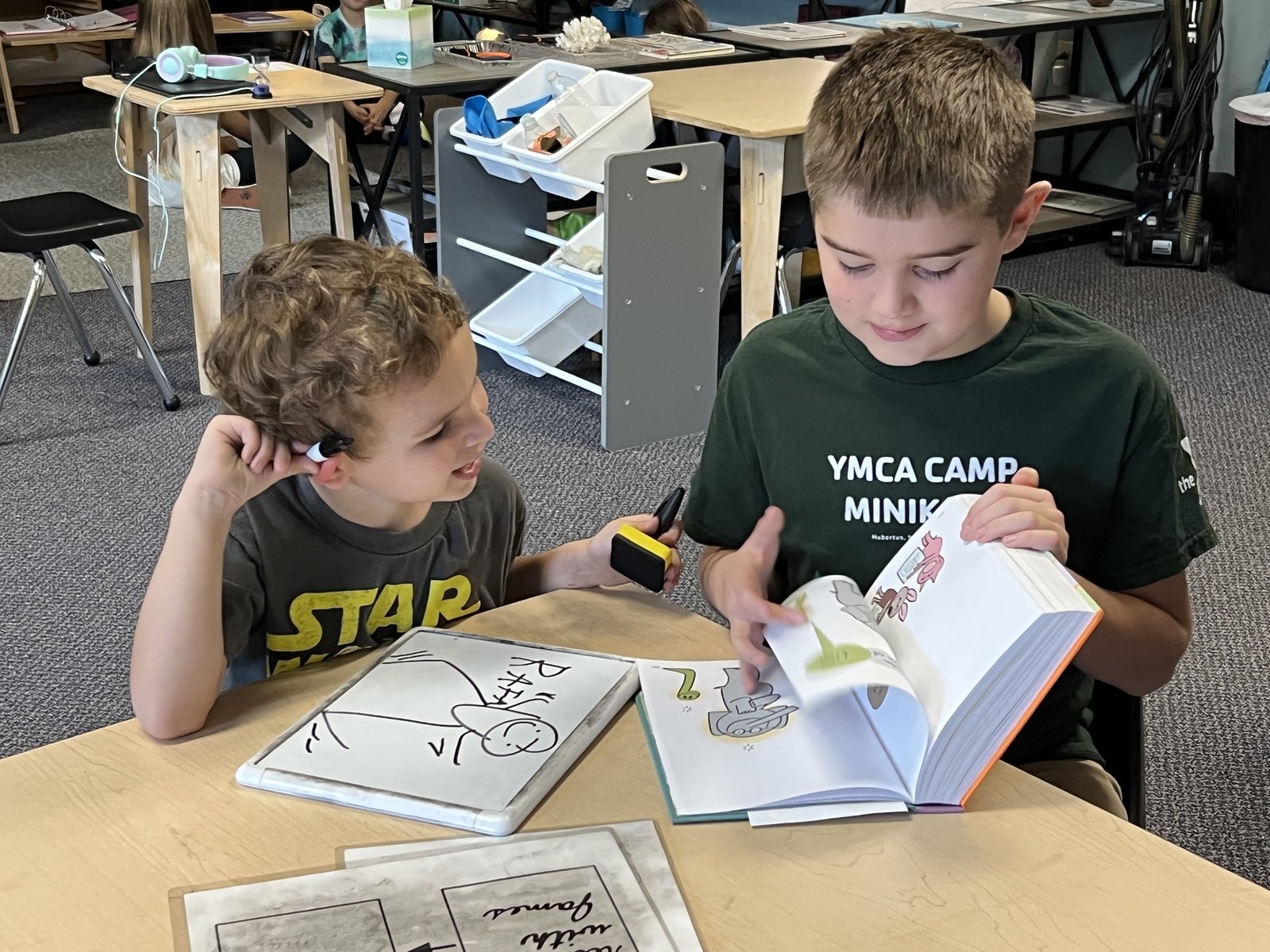
- Collaboration: The Montessori environment is naturally designed for collaboration by including multi-age classrooms. Children are able to learn from students older and younger than themselves and develop peer mentoring relationships. Group work is encouraged, allowing students to bring forth ideas and hear feedback from their peers as they continue through the process of completing a work or researching a topic.
- Critical Thinking: Montessori materials are designed to focus on one set of skills and contain a control of error, encouraging children to continue working through a problem using critical thinking skills. The Montessori classroom inherently contains the tools needed for students to answer their own questions.
- Creativity: The Montessori environment allows children the freedom to choose their own work and to explore the materials on their own. Children are encouraged to follow their interests and to use their questions as a guide. Lessons are presented in a way that sparks curiosity and imagination.
The stars, earth, life of all kinds form a whole in relation with each other, and so close is this relationship that we cannot understand a stone without some understanding of the great sun! No matter what we touch, an atom or a cell, we cannot explain it without knowledge of the wide universe.


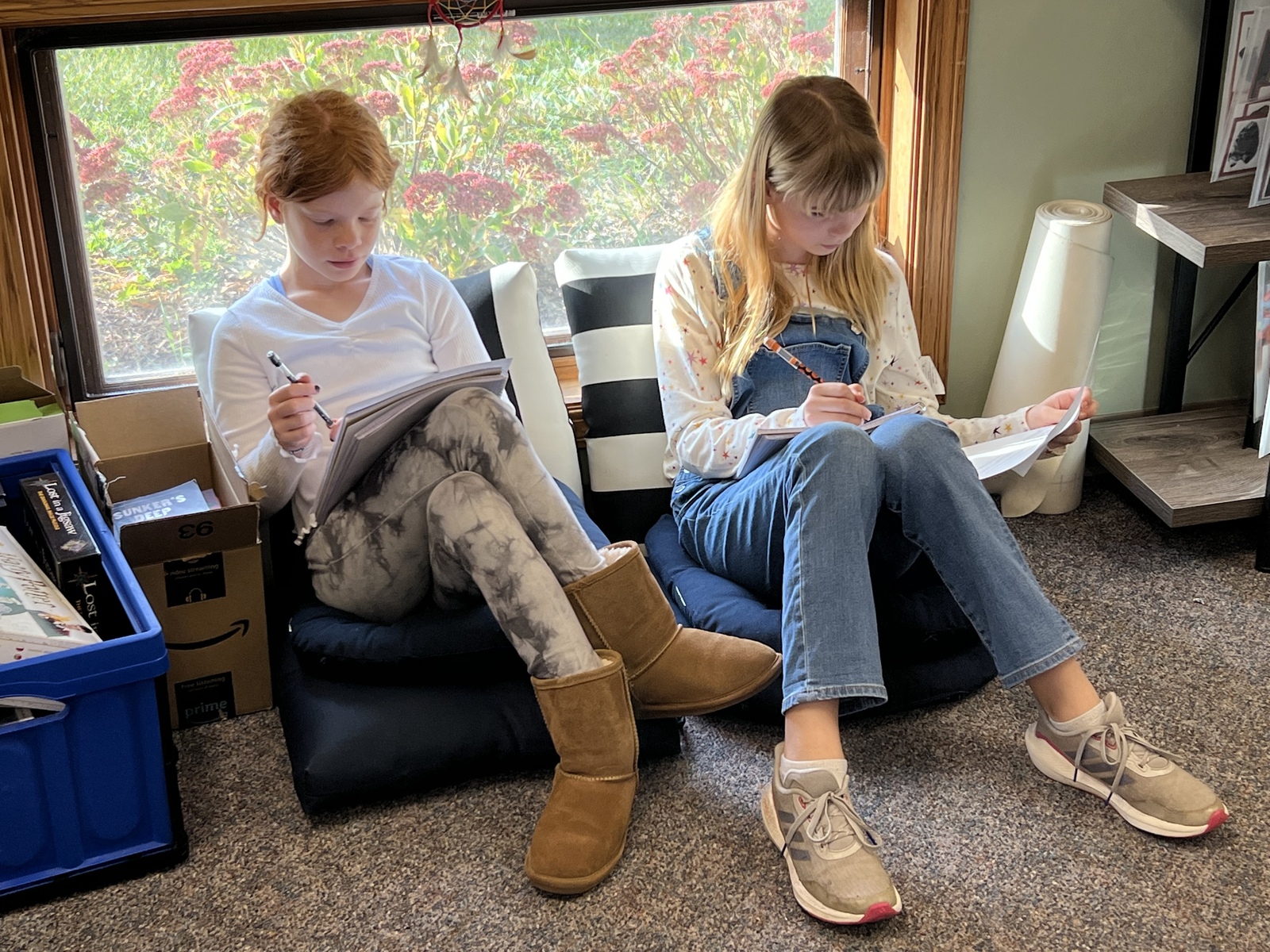
Secondary (Grades 7-12)
The Secondary program begins the ‘third plane of development’ continuing the group work they began in Elementary with an in-depth focus on collaboration, leadership, and service.
The Secondary program includes Secondary I/ Middle School (7th-9th grade) and Secondary II/ High School (10th-12th grade).
The Montessori focus on student-led, hands-on learning continues in our Secondary program. Dr. Montessori believed that, as students develop at this age, they are ready for many different types of education. One focus at this age is caring for the land where their school is located and serving their community. This leads children to a deeper connection with nature and an understanding of their responsibility to care for the Earth and the people who live around us.
Each lesson, research project, or group activity emphasizes the importance of cooperation and collaboration in preparation for adult work and personal relationships. We strive to help all students find joy, curiosity, kindness, and a sense of purpose each day as part of the classroom and school community.
To build leadership skills, regular community meetings are held where students can address concerns about the classroom environment, develop solutions together, suggest research projects, and share interests they are exploring. Students are encouraged to question and challenge work and presented material in groups to discover their own ideas, research, and thoughts.
This program features immersive activities, including overnight camps, service projects, and volunteering. Students will learn the rigorous curriculum through lessons, seminars, group work, and individual projects.
🕛 SCHOOL DAY: Monday-Friday, 8:15 AM-3:15 PM.
SECONDARY CURRICULUM
Secondary I - Middle School
- Subjects: Reading, Writing, Math, Science, Social Studies, Health, and Social-Emotional Learning (SEL).
- Topics: Origins, Assimilation, Evolution, Transformation, Exploration, Persuasion, Community & Citizenship, Identity
Secondary II - High School
- English & Literature: Fiction, Non-Fiction, Poetry, Research Essays
- Math: Algebra I, II, Geometry, Pre-Calculus, Calculus, Pre-Statistics
- Science: Biology, Chemistry, Physics, Environmental Science, Anatomy & Physiology
- Social Studies: World Geography, US History, Personal Financial Literacy, US Civics & Government, Civics Exam, Psychology
- Health: Nutrition, Sexual Education, CPR, Healthcare, Practical Life Skills
- Business: Micro-Economy
- Grade 12 only: Working part-time, internships, WCTC dual enrollment